All Posts By

Bernolf Kramer

Unknown photos from 1944 show the grounds of the former Sobibor death camp

By Uncategorized

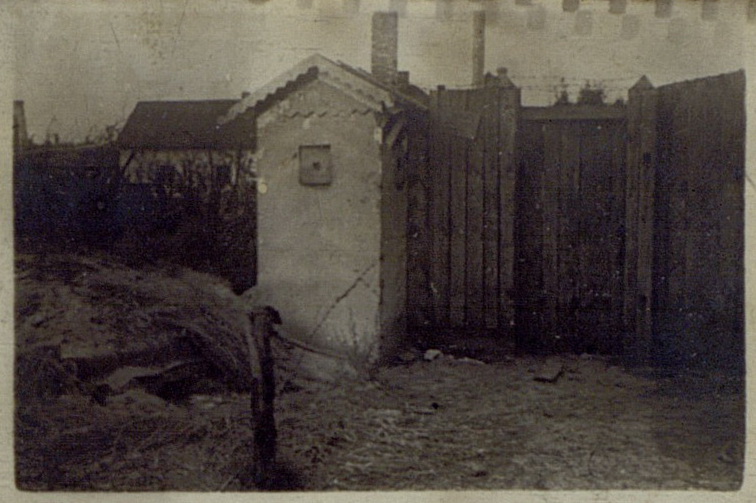
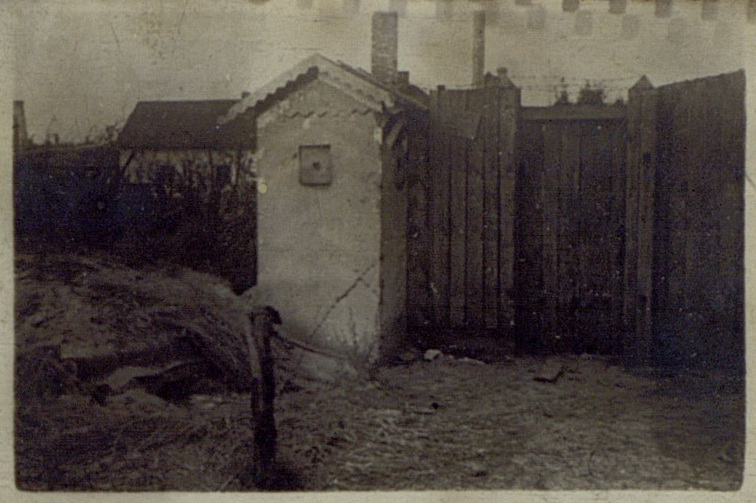
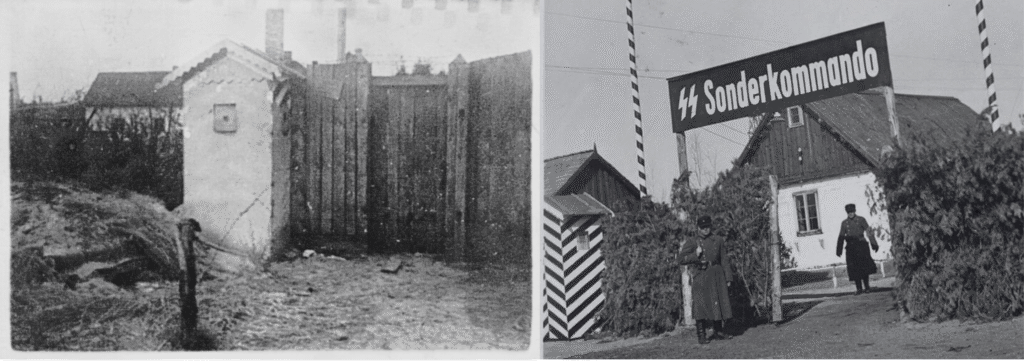
Poort met Wachthuisje bij de ingang van de Himmelfahrtstrasse in het voormalige Lager 2, augustus 1944. Links de boerderij.

Gate with guardhouse at the entrance to Himmelfahrtstrasse in the former Lager 2, August 1944. The farm is on the left.

The re-discovery of a 1944 photograph in the Russian State Archive is partially rewriting the history of the Sobibor extermination camp. This photograph, part of a series of 17 images, reveals the gate to the infamous Himmelfahrtstrasse (the Slauch) and the farmhouse (Erbhof) in Lager 2 (Camp 2) at Sobibor. Until this find, it was widely believed that all traces of the camp were completely erased by the Nazis immediately after the prisoner uprising on October 14, 1943.

This re-discovery confirms that recognizable structures of the camp were still present in the summer of 1944. As Bernolf Kramer of the Sobibor Foundation, who rediscovered the photos, notes, “The gas chambers were blown up, but you cannot erase a place where 170,000 people were robbed and murdered.”

The photos are part of a report dated August 19, 1944, compiled by Lieutenant Colonel Volski, acting head of the political department of the NKVD (Soviet internal security) troops of the 1st Belorussian Front, during an investigation into Nazi crimes in liberated Eastern Poland. The documents and photos were made public online by the Central Archive of the Ministry of Defence of the Russian Federation in 2018 to mark the 75th anniversary of the Sobibor uprising.

Some of the photos were previously published in a brochure about the 2019 archaeological excavations edited by Marek Bem: Sobibór. archeologia terenu po byłym
nazistowskim obozie zagłady 2000-2017
. British historian Hannah Wilson also mentioned them in her dissertation (2023): “Let My Cry Have No Place, Let It Cry Through Everything”: The Material Memory of Sobibor Death Camp. It is unknown why these photos were not added to later research results.

What the photos also show

Beyond the Himmelfahrtstrasse gate and the farmhouse, the series of photographs also depicts:

  • The guardhouse at the Himmelfahrtstrasse entrance.
  • The ‘Rampe’ (platform) where trains arrived.
  • Quarters of the camp guards.
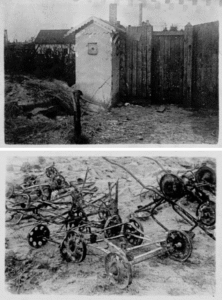
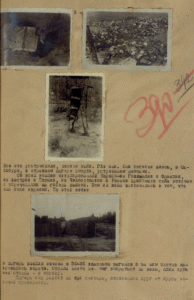
  • Gripsing images of piles of personal belongings, including prams (strollers), artificial limbs, hair, dinnerware, and walking sticks—the possessions of the murdered victims.
  • Three survivors of the uprising: Abrahm Kohn, the Dutch woman Ursula Stern, and Israel Trager.

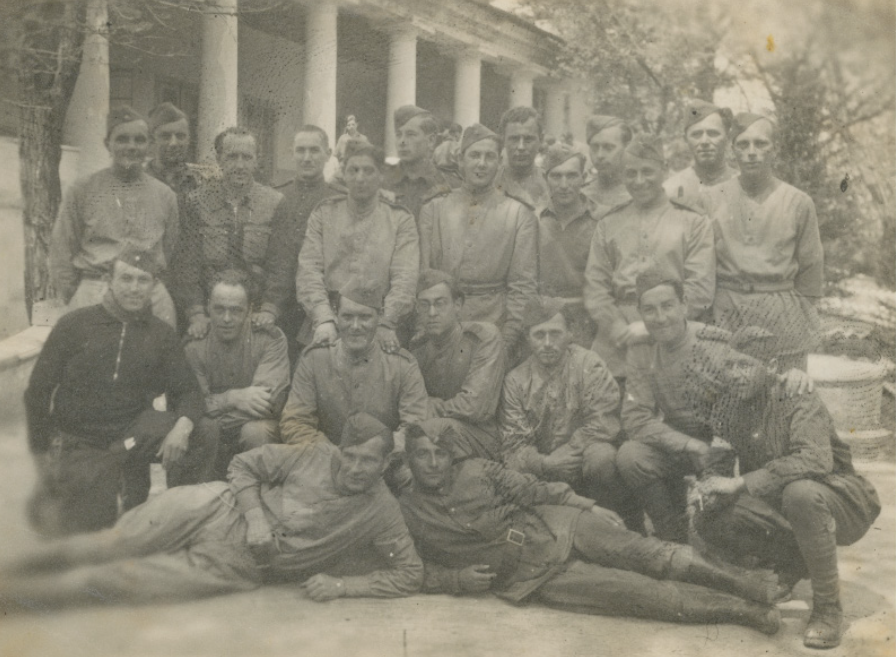
In 1944, Ursula Stern photographed Soviet soldiers. Copyright: Safran family

Ursula’s confirmed her presence in Sobibor in 1944 in het testimony in Hagen in 1965 as stated in the book of her grandson: “After the liberation, Ula went to the house of a wealthy Jewish woman who sheltered many Jewish survivors in the Polish city of Włodawa. There she met her friend from the camp, Selma Wijnberg, and her fiancé, Chaim Engel. Ula and Selma knew that Polish and Russian Jews hid valuables and jewelry in their torn clothes and buried them in the camp ground to prevent them from reaching the Germans. They decided to go look for them, so they would have the means to return to the Netherlands. The three of them went to the death camp to see what was left.”

Abrahm Kohn and Israel Trager also describe their presence in the area around Chełm and Sobibor in the summer of 1944 in post-war testimonies.

According to archaeologist Ivar Schute, who was involved in the excavations in Sobibor, the gate in the photo is the entrance to the Schlauch or Himmelfahrtstrasse in Lager 2 (Camp 2). He immediately recognized the location because he had excavated the foundations of the guardhouse and the gate, but was not familiar with these photos. Erik Schumacher, author of the book about the archaeological research that made Sobibor’s history visible, was also unaware of these images. Why they were not documented earlier since their release in 2018 is unknown.

The farmhouse (Erbhof) is also visible in the photos in the Niemann album that was discovered in Germany in 2015. During the camp’s operation, the farmhouse served, among other things, as a feeding area for geese, which were driven out as the deportees were herded to the gas chambers through the Himmelfahrtstrasse.

The discovery confirms that in the summer of 1944, the camp grounds not only still contained some recognizable structures, but also that many goods belonging to deportees and human remains were still visible.

Russian researchers and journalists, in the wake of the Soviet army, collected witness statements from survivors, local residents, and former Trawniki in 1944. The NKVD (People’s Commissariat for Internal Affairs) was the Soviet government organization responsible for internal security. It also included the notorious Main Directorate of State Security, which dealt with the tracing of “enemies” at home and abroad. The NKVD was later transformed into the KGB (now FSB) and the MVD, which still exists in present-day Russia. The Russian State Archive contains several such documents.

The findings were published in, among others, Komsomolskaya Pravda (September 2, 1944) and Amigoe di Curaçao (September 22, 1944), which also featured a short interview with Selma Engel-Wijnberg.

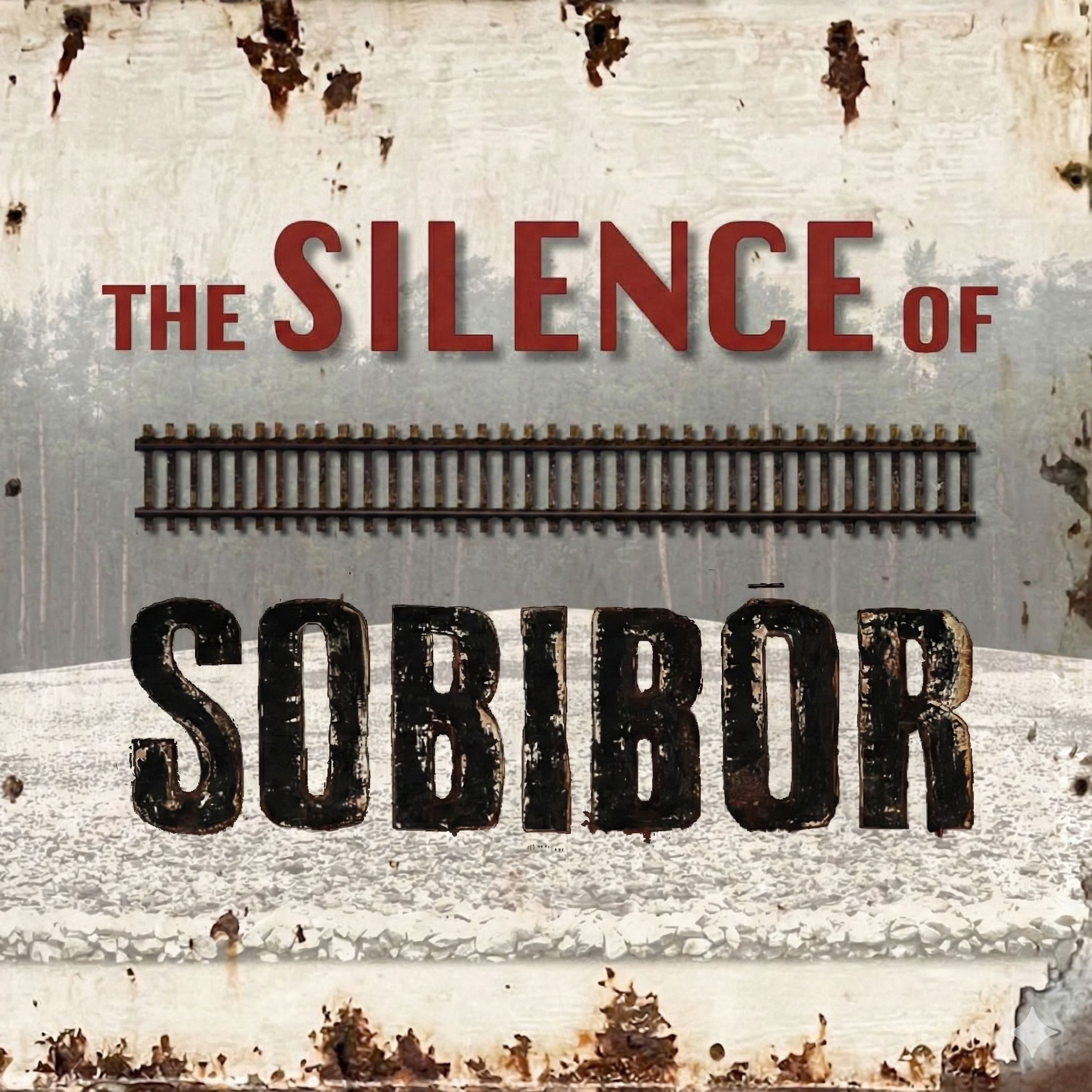
Listen to our new seven-part podcast (in Dutch) about, among other things, the rediscovered photos: De stilte van sobibor (English-language podcast, The Silence of Sobibor, to follow later).

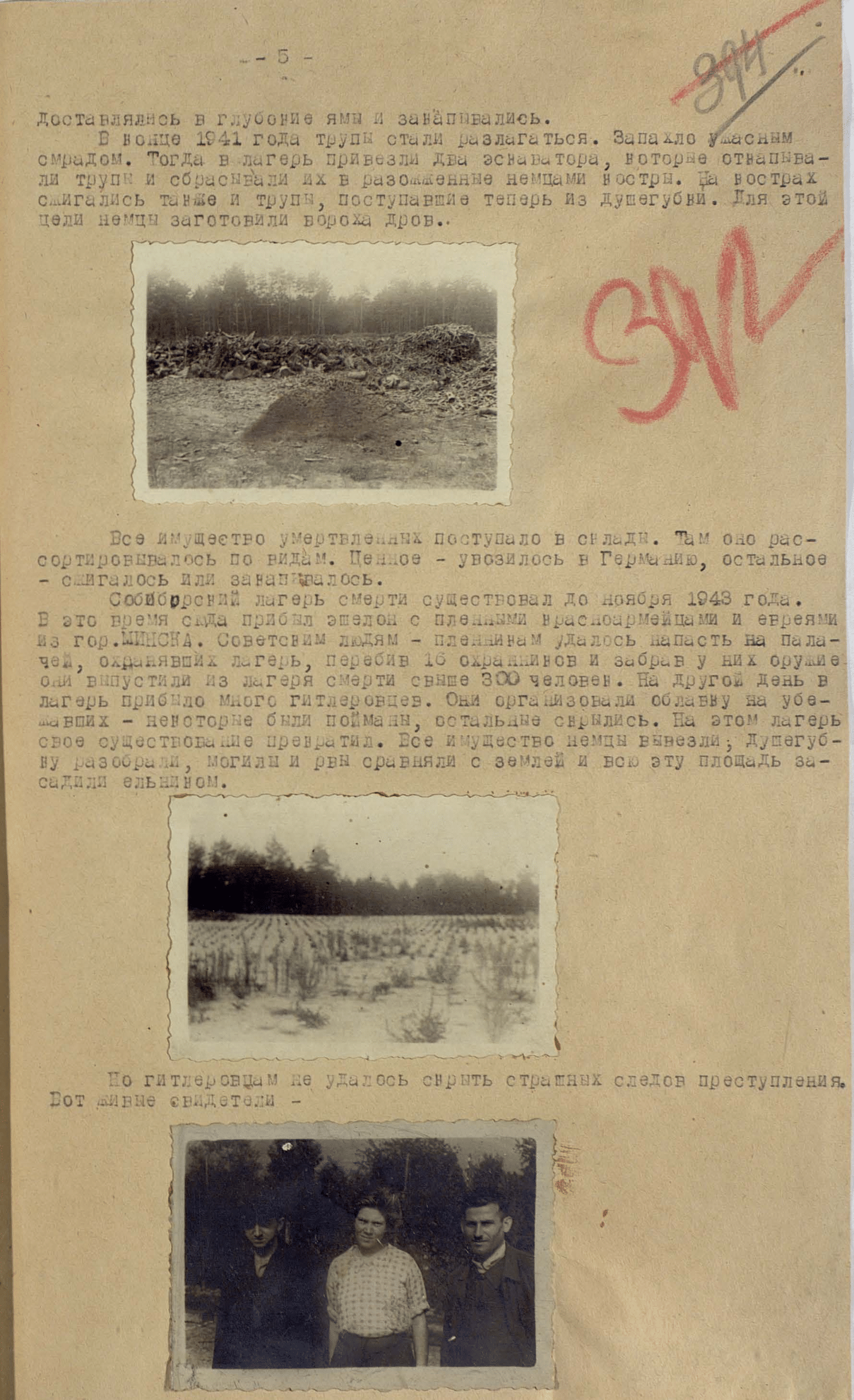
Pagina 5 van 6 van het verslag over Sobibor van 19 augustus 1944. Foto1: Goederen van gedeporteerde Joden. Foto 2: Blik op de aanplant op de massagraven en het voormalige Lager 3. Foto 3: Abrahm Kohn, Ursula Stern en Israel Trager.

View Volski’s full report here, including all 17 photos and an English translation of the Russian text.


New podcast “The Silence of Sobibor” sheds new light on Sobibor

By Uncategorized

Annual Event: Sobibor – Resistance and Hope. The Uprising That Made History

On Sunday, October 12, 2025, at the Dutch Resistance Museum in Amsterdam, Stichting Sobibor will present the seven-part podcast series The Silence of Sobibor, featuring stories from survivors, descendants, and experts.

During the production of this series, previously unseen photographs of the Sobibor extermination camp surfaced. These images originate from the Central Archive of the Ministry of Defense of the Russian Federation.

Although the photographs were discovered in 2018, they have remained unknown until now. They shed new light on the camp, showing a chaotic site, partially intact, shortly after its liberation by Soviet troops. During the event, Erik Schumacher (NIOD), Bernolf Kramer (Stichting Sobibor), and podcast creator Richard Grootbod will discuss the significance of these findings.

More information and tickets (reservation required): Dutch Resistance Museum Amsterdam

On August 19, 1944, Lt. Col. N.I. Volsky published a report on his findings in Sobibor.

The 17 photographs, taken on August 15, 1944, depict the guardhouse at the entrance, the “Rampe” where trains arrived, and the quarters of the camp guards. Heart-wrenching images show piles of baby carriages, tableware, and walking sticks. “The gas chambers were blown up,” says Bernolf Kramer of the Sobibor Foundation, “but a place where 170,000 people were robbed and gassed cannot be erased.”

Lt. Col. N.I. Volsky published a report on his findings in Sobibor on August 19, 1944.

The authenticity of the photographs has been confirmed, including by the family of Dutch survivor Ursula Stern, who appears in one of the images. The photos support suspicions that parts of the camp were not fully dismantled after the October 1943 uprising, contrary to previous assumptions.

Podcast Series: The Silence of Sobibor

The Silence of Sobibor is a production by Audiodroom Podcast Productions in collaboration with the Sobibor Foundation. Creators Patty-Lou Middel-Leenheer and Richard Grootbod spent a year and a half developing the series, which tells stories about the little-known Sobibor camp.

Sobibor was a secret death camp in Nazi-occupied eastern Poland, part of Aktion Reinhard, where over 170,000 people were murdered. Unlike Auschwitz, Sobibor remains largely unknown to the public.

Between March 2 and July 1943, 34,313 Jews were deported from the Netherlands to Sobibor in 19 transports. Almost all were murdered upon arrival. A small number were selected to work as Sonderkommando. On October 14, 1943, these “work Jews” organized an armed uprising. Hundreds managed to escape.

Only eighteen Dutch survivors returned from Sobibor: three men and fifteen women. Two of them, Selma Wijnberg and Ursula Stern, were held in Sobibor; the others were transferred shortly after arrival.

Among them was Jules Schelvis, who later authored several seminal works on Sobibor. King Willem-Alexander referenced Schelvis in his speech on May 4, 2020: “Sobibor began in the Vondelpark, with a sign that read ‘No Jews Allowed.’”

The photographs will be shown on October 12 during Sobibor: Resistance and Hope at the Dutch Resistance Museum. The podcast will be available from that day via app.springcast.fm/podcast/de-stilte-van-sobibor. The images will be shared later via our website.


Comparison of the guardhouse at the entrance to the former Sobibor death camp in 1944 and 1942. (Photo from 1942 is from the Niemann Album, United States Holocaust Memorial Museum)


Reflections from the Chairperson and a Brief Look Ahead

By Uncategorized

This past year marked the 25th anniversary of the Sobibor Foundation, but we didn’t dwell on it for long.

Although we all hoped for a quieter year in 2024, the conflicts in Ukraine and Israel/Gaza remain ongoing. Polarization is increasing, and public discourse is becoming more intense. This was evident not only during the opening of the National Holocaust Museum, where the Sobibor Foundation was present, but throughout the year. It keeps us vigilant and casts a dark shadow as we remember the past and express our hopes for the future. We remain convinced of the need to continue sharing our message.

Sobibor commemoration
Fortunately, there was great interest in the June 1 commemoration at the Vondelpark. Beforehand, students from the Utrecht Theatre School performed “The Child is No More”, about the evacuation of the Central Israelite Orphanage in Utrecht in 1942. This performance was staged outdoors for the first time, a real challenge for director Gilles Groot. It’s heartwarming to see young people immerse themselves in the past, imagining themselves as the children of that time; it’s a beautiful way to add an extra dimension to remembrance.

Natascha van Weezel was our speaker. Her nuanced vision of a tolerant and inclusive society resonated with all. Her strength lies in staying true to herself while contemplating the world, thereby inspiring individuals to reflect on their personal contributions.

To mark the foundation’s 25th anniversary, we organized a gathering at the Blauwe Theehuis after the commemoration. This follow-up conversation proved valuable, fostering intergenerational connections. This post-commemoration gathering will now become a regular part of our events.

Holocaust education
This year, we also focused on strengthening our network. This enabled us to participate in initiatives led by the National Coordinator for Combating Antisemitism (NCAB) and the National Plan for Strengthening Holocaust Education. Our teacher program, part of our Aktion Reinhard Field Trip, aligns well with initiatives being developed and rolled out in January 2025.

We are also pleased with our new collaborations with the Anne Frank Foundation and the National Committee 4 & 5 May. They contributed to the program for the second youth reunion day at the National Holocaust Museum, organized for students who participated in the International Youth Conference in Sobibor. The international Anne Frank Youth Network in the Netherlands and the Young Impact Foundation were introduced to the students. These additions enrich the experiences gained from such trips. Many thanks to the Province of Gelderland for making this possible.

Governance
This year also saw a change in our board. We bid farewell to Fergal van de Wouw, who conducted a survey on the importance of youth trips to Sobibor and initiated efforts to strengthen our network. Thank you, Fergal. Sophie Bots, an enthusiastic young woman, has taken his place and will focus on youth policy. Welcome, Sophie.

In April, the NIOD Institute for War, Holocaust, and Genocide Studies organized an excellent international symposium on the archaeological finds in Sobibor and their significance. Two exceptional books were published on the topic. The poignant film “Deadly Deception at Sobibor” was screened at the Resistance Museum in conjunction with the symposium. The film, directed by Gary Hochman, documents the work of archaeologists Wojciech Mazurek, Yoram Haimi, and Ivar Schute since 2008.

During our annual commemoration of the Sobibor uprising, co-organized with the Resistance Museum, these topics were revisited. Erik Schumacher and Rosanne Kropman spoke about their respective books inspired by the Sobibor excavations. The event, newly titled “Sobibor: Resistance and Hope”, aims to appeal to younger generations to inspire attendance.

At “Sobibor: Resistance and Hope,” the Jules Schelvis Youth Award was presented to Tess Sluijs and Sophie Brinkhof from the Sint Maartenscollege in Voorburg. They created a research project on two survivors of the uprising, Selma Wijnberg from the Netherlands and Thomas Blatt from Poland. The jury commended ‘their fresh perspective, consistent approach, and unique storytelling about Sobibor’. Congratulations, Tess and Sophie, and thanks to jury members Jeroen van den Eijnde, Doede Sijtsma, and Maarten Eddes.

In April, the Sobibor Foundation participated in an international seminar on Aktion Reinhard in Lublin, Poland. Few people realize that Lublin was central to the Holocaust’s operations. The Grodzka Gate – NN Theatre organization is dedicated to preserving the memory of Lublin’s Jewish community before and during WWII.

At the invitation of board member Petra van den Boomgaard, I spoke at the May 4 commemoration organized by students of the University College Utrecht. These students also conducted remarkable interviews with survivors this year.

International
In 2024, we organized both the remembrance and the Aktion Reinhard fieldtrip journeys. Interest was so high that we conducted a second remembrance journey in the autumn. During this trip, participants were able to unveil their stones on the lane of remembrance. The foundation added 20 new stones, bringing the total to 410. It remains to be seen if the Sobibor Museum will allow more additions, but we continue our efforts.

Our social media presence has grown significantly, attracting international attention. As a result, we decided to publish an English newsletter several times a year and make our website bilingual.

Finally, looking ahead, April 8, 2025, will see the release of the long-awaited biography of Jules Schelvis by Cees Banning. We are also exploring the possibility of organizing our youth trip to Sobibor and creating a podcast. The podcast will be produced by Audiodroom, known for their series “Erased” about Anne Frank’s friend Ilse Wagner, who was murdered in Sobibor at 14. We aim to release this podcast in 2025.

A thank you to the board for all their work, and I look forward to 2025!

Christine Gispen-de Wied
Chairperson Sobibor Foundation

Sobibor Commemoration Trip October 2024

By Uncategorized

by Noor Hellmann

The signpost to Sobibor camp is inconspicuous; you could easily miss the turn. The bus leaves the straight two-lane road and bumps along the poorly maintained asphalt, through a marshy area with pine trees, birches, and other deciduous trees now in autumn colors. Occasionally, the forest gives way to open fields – the surroundings are more beautiful than I had imagined.

This memory goes back to 2015 when I first joined a memorial trip organized by the Sobibor Foundation. We stayed overnight in Lublin, in eastern Poland. Now, nine years later, I am making such a group trip again, this time with three generations of my family. I have a déjà vu as we check into the same hotel, on the edge of the former ghetto in the city center. Some buildings in the old center have bricked-up windows with large black-and-white portraits of former residents. From my hotel room, I have a view of a facade with a photo of a woman in a white dress, as if she is sitting on her balcony.

Quiet Corner

In the pouring rain, we leave for Sobibor the next morning. After two hours, there is a stop in Wlodawa to visit the baroque synagogue, which now serves as a Jewish museum. Little remains of the rich Jewish life in the town before the war. Only about a hundred Jewish residents survived the Holocaust.

From Wlodawa, it is another sixteen kilometers to Sobibor. We approach the border with Ukraine and Belarus; the war in Ukraine seems an unreal idea in this quiet corner. Much further away, bombs, shells, and rockets are also raining down: I feel that the escalated conflict between Israel and Hamas accompanies our journey like a dark cloud, although remembrance must take precedence. On the way, I read “Letter in the Night. Thoughts on Israel and Gaza” by Chaja Polak. The author lost her father in the war, and her late husband almost his entire family. In her beautiful essay, she expresses her confusion and dismay over the hopeless struggle between Israelis and Palestinians. She analyzes with a nuanced view and does not shy away from painful questions. Yes, I think as I read her, yes, that’s how I see it too.

Nineteen Trains

My first visit to Sobibor was an emotional experience. I had read about the camp and knew television images of the railway, the platform, and the rusted station sign Sobibor. But walking around there was something else entirely. Here, my grandfather, 39 years old, had taken his last steps. From the platform, it was a few hundred meters to the gas chambers. With 1251 others, he was deported on the fifth train from Westerbork to Sobibor, which reached its destination on April 2, 1943, near the village of Sobibor.

In total, nineteen trains arrived from Westerbork. They transported over 34,000 people, a third of the total number of Jews killed from the Netherlands. The complete name lists are included in “Extermination Camp Sobibor,” the standard work by survivor Jules Schelvis. Sobibor, in operation from May 1942 to October 1943, was an efficient extermination industry that was an important link for the Nazis in “solving the Jewish question.” About 170,000 Jews were killed there immediately upon arrival; it could be significantly more, estimates vary. These are the cold numbers, rounded for convenience, as if each life does not count.

Individual Stories

That my two daughters are coming along this time gives the trip extra meaning. They are in their twenties; the war and the death of their betrayed and deported great-grandfather are far behind them, but emotionally, the distance is not so great. They feel connected to the story of their grandfather Paul, who, according to the Nazis, had no right to exist. As a seven-year-old boy, he suddenly had a star sewn onto his clothes. He had no idea what it meant to be Jewish; nothing was done at home about the holidays and traditions. Not long after, the star was torn off again when his parents and he had to go into hiding, all three in different places. The last time he saw his father was on the garden path of his hiding place, where they said goodbye to each other.

It is individual histories that bring the past close. During our trip, we not only visit the impressive Polin Museum in Warsaw, which pays extensive attention to the Holocaust that cost three million Polish Jews their lives, but we also go to the Jewish Historical Institute in the capital. The institute possesses the clandestine archive “Oneg Shabbat,” a kind of testament of the ghetto residents in Warsaw. Historian Emanuel Ringelblum was one of the initiators who called on his fellow residents to record as much as possible on paper. The collected testimonies and documents were hidden in cans and milk churns. “What we could not shout to the world, we buried underground.” After the war, a wealth

of information was found – one of the used milk churns stands rusty and battered on display.

Uprising

For a long time after the war, little was known about Sobibor; it seemed a kind of blind spot in the collective memory. Those who knew the way there found a desolate place in a dark forest, where seemingly little remained that referred to the mass murder that had taken place there. Imagination had to do the work. Already in the middle of the war, the visible traces were erased. The reason was the well-prepared uprising on October 14, 1943. About three hundred prisoners managed to escape – most of whom unfortunately did not survive the flight. Twelve SS men and several Ukrainian guards were killed. For the SS headquarters in Berlin, the breakout was a severe setback, and it was decided to immediately raze the camp to the ground. Where the barracks stood, the Germans planted young trees.

In 2007, a thorough reconstruction of the site began. An international team of archaeologists discovered the foundations of the gas chambers and over the years unearthed many lost and abandoned personal belongings. It became clear that the Himmelfahrtstrasse, the route to the gas chambers, was located elsewhere than previously assumed. The project was completed at the end of 2023.

Eyewitness Accounts

When our bus arrives at the empty parking lot, the appearance of the camp has changed, but the platform looks just as it did before the renovation. Weeds grow tall between the concrete slabs. The track is used for timber transport in the summer, and passenger trains also run. A current timetable at the small station across the way shows that the train between Wlodawa and Chelm passes four times a day.

The rain has turned into a light drizzle as we all stand on the platform. Petra van den Boomgaard and Maarten Eddes, who organized this trip, introduce our visit with an informative story about the 1943 uprising. Although the Nazis wanted Sobibor to remain a “top secret,” according to writer Jules Schelvis, much has been reconstructed afterward. Photos from the estate of SS camp commander Johann Niemann, which surfaced a few years ago and were published in the book “Fotos aus Sobibor,” provide a picture of the camp. The eyewitness accounts of the uprising are also very important. My daughters and the other four young people in our group take turns reading quotes.

Meanwhile, a stiff, old dog shuffles out of a garden opposite the platform. It is the garden of a green wooden house with a red roof. It once served as the camp commander’s quarters; the Germans left it standing when they hurriedly departed. This house and the two adjacent houses, right next to the campgrounds, are inhabited. I was surprised by this the last time as well.

Journalist Rosanne Kropman spoke for her 2023 book “The Darkest Dark, a History of Sobibor” with Jerzy Zielinski, the resident of the green house. His wife was born there after the war. Kropman writes: “It’s not really nice to live here, he thinks. The woodwork from 1923 needs a lot of maintenance, the house is not insulated and is heated with a wood stove. But living in a guilty landscape does not bother him. (…). The track over which the trains were shunted into the camp ran a few meters from Zielinski’s front door; his backyard overlooked Lager I during the war, where the forced laborers lived. It was within the tightly guarded double fences. ‘What does it matter,’ says Jerzy Zielinski. ‘The commander just lived here, just like I live here now.'”

Naming Names

Since the renovation, Sobibor has a new museum and memorial center. The large building is the first thing you see upon arrival. Inside, excavated artifacts are displayed. Nail scissors, combs, plates, and cutlery – all sorts of items that the prisoners thought they needed when they were misled into thinking they were going to a “labor camp.” There is a lot of information in text and images, including from Niemann’s album, such as a photo of some cheerful SS men and their wives, sitting outside at a table. According to the caption, the man in the middle is Erich Bauer, the “gas master” of Sobibor. Paul Celan’s chilling poem “Death Fugue” comes to mind: suddenly I understand the line “death is a master from Germany.”

Behind the museum, the campgrounds stretch out. Initially, you could see up to the edge of the forest; now there is a high concrete wall around it, suggesting that we are cut off from the world. Within the enclosure, at the edge of a gravel plain, we hold a memorial with the group under a gray cloud cover. Inaccessible in the distance lies the ash mound, covered with gravel. A final resting place for the dead. The relatives name their murdered family members, sometimes it is a long list. I am moved when my father steps forward and says: “Bernhard Hellmann, my lost father. I miss him, and it only gets worse with the years.” Words that, in their simplicity, hit the core. A crow caws as we stand silent for two minutes, the treetops rustle. Are we standing here in a “guilty landscape” where you can hear the souls of the deceased whisper?

Great Spotted Woodpecker

In the memorial avenue, relatives have placed memorial stones, varying in size and provided with new silver-colored nameplates. After some searching, we find the stone for Bernhard. We place pebbles and light a candle in a plastic holder, a lid with holes protecting the flame from wind and rain. It feels as if we are finally standing at his grave after a long journey, tears prick our eyes. Then, nearby, a soft and regular tapping suddenly sounds. It turns out to be a great spotted woodpecker high in a pine tree, busily pecking at the trunk. My grandfather, who as a great animal lover studied animal behavior from a young age, would have observed him with interest.

When we return to the Netherlands after four days, we come from another world. A sense of solidarity has developed in the group. While we were served Jewish meals at long, beautifully set tables in the evenings, we listened to each other’s stories, surrounded by the shadows of the people who disappeared and never returned.

Sobibor: Resistance and Hope. Tunnel and the captain.

By Uncategorized

Retrospective Sobibor: Resistance and Hope. Tunnel and the captain.

At the end of the session, Ivar Schute, the Dutch Holocaust archaeologist, raised his hand and asked, “Was there a connection between the escape tunnel and the murder of the captain?” This question was the culmination of the entire meeting.

Opening

On the afternoon of October 27, Liesbeth van der Horst opened the gathering. As the director of the Dutch Resistance Museum, she introduced the new title of the annual event: Sobibor: Resistance and Hope. She also proudly announced that the museum had expanded its permanent exhibition to include a focus on World War II in the colonies and the subsequent struggle for independence.

Christine Gispen, chairperson of the Sobibor Foundation, emphasized the theme of hope — hope for a better world order. She then seamlessly introduced the two upcoming speakers, connecting their contributions with finesse.

The captain

Jozeph Jacobs,the Dutch captain  of The Royal Netherlands Marine Corps, was the focus of journalist Rosanne Kropman’s presentation. Thanks to social media, we now know who this courageous little man was and even have photos of Jacobs. In one of the chapters of her book The Darkest Darkness, she talks about the Dutch preparator of the infamous uprising on October 14, 1943. Jacobs had only recently arrived at the camp and was known among the so-called work Jews as someone actively seeking information about escape opportunities. Meanwhile, he didn’t know that the work Jews in the strictly segregated Lager III were secretly digging an escape tunnel.

Archeology

This tunnel was uncovered by archaeologists in modern-day Sobibor. About these excavations Erik Schumacher of the NIOD wrote Traces of Sobibor. In it and in his presentation, he makes the connection between individual objects from Sobibor with the victims and with their lives before the Holocaust. Tens of thousands of objects have been excavated from the soil. And only a few can be traced back to individuals. Yet Schumacher argues that every nameless object, every brooch, toothbrush, lipstick or mug speaks of individuality. The hope to remain human and stubbornly cling to it. That too is resistance and, I add myself, hope.

In the end, the tunnel was betrayed. And because the Dutch Jews in Lager III were blamed, the SS decided to force the Dutch troublemaker Jacobs to name co-perpetrators. He held his jaws together. Along with all the Dutch men, some 70, from Lager II were murdered. This kept hope and resistance alive and was even fueled among the remaining Polish and Russian Jews. On October 14, at the end of the workday, the first SS was killed and the resistance began.

Jules Schelvis Scholar Award 2024: survivors of the uprising

Thanks to the uprisers who managed to survive World War II, Sobibor has become known worldwide. About two (Selma Engel-Wijnberg and Toivi Blatt) of them Tess and Sophie of the Sint-Maartenscollege in Voorburg wrote their award winning high school profile paper (in Dutch).

Hope and resistance

After the conversation led by Petra van den Boomgaard with Kropman and Schumacher, the question came up, “Was there a connection between the escape tunnel and the murder of the captain? Actually, the answer does not matter. What matters is that this afternoon knowledge will be shared about Dutchmen in the camp and the results of archaeological excavations. Also important are the young people taking an interest in people who kept hope under the most difficult circumstances. Kept hope for a better future until the very last moment. Hope to make the horrors of Sobibor known to the world. That is resistance.


Retrospective Sobibor memorial commemoration June 1, 2024

By Uncategorized

On Saturday, June 1st, the Sobibor Memorial Commemoration took place for the third time at the Spiegel monument ‘Sobibor – and what are you doing?’ located at Van Eeghenlaan (entrance to Vondelpark) in Amsterdam. Despite limited publicity beforehand, around 150 people gathered on this chilly June afternoon to attend the commemoration.

Prior to the official commemoration, students from Theaterschool Utrecht, in collaboration with Stichting ‘Theater Na de Dam’, performed a shortened version of their play, Het kind is niet meer, een mens is pas vergeten, als zijn naam vergeten (The child is no more, a person is only forgotten when their name is forgotten), created by theater maker Gilles Groot. Eighteen young actors delivered a poignant performance about the Jewish orphanage in Utrecht, from which many children were tragically murdered in Sobibor.

Christine Gispen-de Wied, Chair of the Sobibor Foundation, welcomed everyone and gave a meaningful speech. She reflected on how Jules Schelvis, 25 years after founding the Foundation, might have felt if he were sitting in the front row today.

Following this, three testimonies were read aloud: one from a perpetrator, one from a bystander, and one from a victim. Natascha van Weezel then read one of her recent columns from the Parool newspaper. Recently awarded the Pim Fortuyn Prize for her courage and commitment to free speech, Natascha moved the audience with a beautiful personal story. The presence of her one-year-old son Max added an extra personal touch to her narrative.

Mirjam van Dam and Ed Boekee complemented Natascha’s words with their beautiful Yiddish music.

After a solemn minute of silence, speakers and attendees placed stones at the monument. The commemoration concluded with a gathering at ‘Het Blauwe Theehuis’ in the Vondelpark, marking the end of yet another dignified, meaningful, and substantial remembrance.

Retrospect International Seminar Tour June 2024

By Uncategorized

The Sobibor Foundation participated in an International Seminar Tour in Lublin and Region June 16-21, 2024: Unveiling ‘Aktion Reinhardt’: A Multiperspective Exploration. The seminar was organized by Brama Grodzka Gate-Teatr NN in Lublin.

Teatr NN is a special organization, housed in the Grodza Gate in Lublin, the gate that originally separated the Jewish and Christian parts of the city. During the war, the Jewish ghetto was built in the neighborhood outside the gate. Teatr NN organizes theatre performances and art productions that all focus on the life of the (pre)-war Jewish population in Lublin. After the war, this population group was never part of the history of the city of Lublin until very recently. Also little is known about the central position Lublin occupied in Aktion Reinhardt, the operational heart of the Holocaust.

The seminar focused on this piece of history, of which Sobibor is one of the three extermination camps. With organizations from Israel, Ukraine, Germany, Italy, Luxembourg, Poland and the Netherlands, the sites were visited and the different ways of commemorating and transferring knowledge to the next generations were discussed. A fascinating network that showed how much we can still learn from each other to make a ‘common’ narrative possible and this part of history of the Holocaust. For more information about the Brama Grodzka Gate and their activities, see this link.

In terms of museums, the Grodzka Gate is worth a visit. In this interesting building, 43,000 folders have been collected, 16,000 interviews have been recorded, giving a picture of pre-war life. The folders represent every inhabitant of Lublin before the war. At least half of the folders are empty; no name, no addresses, no pictures of the people who were taken away. The Grodzka Gate works every day to search for and collect new data. An impressive task, which does not leave anyone who visits the Teatr unmoved.

Remembrance trip May 2024

By Uncategorized

This past May, Laurens van Hofslot and Olivia Rice, students from University College Utrecht, participated in the commemorative trip. Their involvement was linked to their participation in the interview project of Stichting Sobibor. For this project, both have interviewed various survivors and descendants of the Holocaust. The main goal of this ongoing project is to document the wartime and life stories for families. As a culmination, Olivia and Laurens joined the commemorative trip to Sobíbor.

Laurens writes that although he is deeply involved with this topic through the interview project, he himself does not have a Jewish background. He was initially worried that this might make him feel like an outsider, but nothing was further from the truth. Olivia and he were warmly welcomed into the group, and this trip provided him with valuable new insights and knowledge. The most significant learning experience, writes Olivia, was not from the different museums or places we visited, but from being part of the group. The group was open, friendly, and always ready for a chat during bus rides and pleasant dinners. These interactions were not merely superficial; Olivia also learned a great deal about various aspects of Jewish culture.

During the trip, we visited many different places. Our journey started in Warsaw, where we arrived by plane. Our first visit was to the Jewish Historical Institute, where we received a fascinating and shocking insight into life in the Warsaw ghetto and how the Jewish resistance was organized during the war. After this visit, we traveled to Lublin, where we stayed at a hotel during the trip. On days 2 and 3, we visited Wlodawa with the group to see two synagogues. These synagogues can be visited but are no longer in use. There, we learned more about the history of the Jewish community in this region. From Wlodawa, we proceeded to Sobíbor camp, where we received a brief explanation of what the camp looked like and how it operated, complete with testimonies from survivors. There was also an opportunity to visit the museum and see the memorial path with the stones.

In accordance with Jewish tradition, we also held a memorial ceremony at the ash mound, where people could name their family members. This moment was very emotional and left a deep impression. It was very powerful to see and hear that, despite everything, these families could be here to honor their relatives, despite the immense suffering inflicted upon their families. Olivia writes how the kind and friendly group made this moment of remembrance in Sobibor camp even more poignant. “I truly realized that day what the impact of the Holocaust really was. It is easy in the academic world to distance yourself from the tragedies and human rights violations you learn about. The commemoration left an impact that ensures I will never do this again.” Laurens also writes that as a student, you can sometimes easily fall into the trap of dealing with Holocaust information in an academic manner, but this commemoration made the stories of the Holocaust tangible for him in a new way. The stark contrast between the location of Sobíbor camp—a seemingly peaceful place in the middle of the forest, where the sun shines, and birds sing—and the atrocities that took place there was jarring.
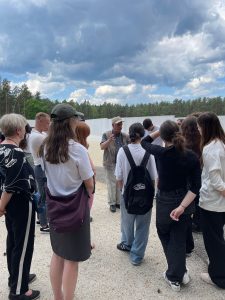
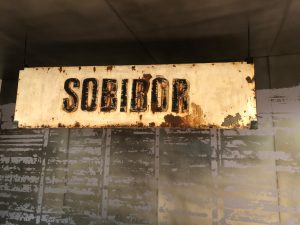

The most remarkable thing to see and experience was the strength of the group, not only in honoring their relatives but especially in their efforts to add an educational element to the trip. On the third day of the trip, a group of Polish students from Lublin joined us. It was a very valuable addition to our second visit, as we could learn a lot from each other, and the descendants and survivors in our group could share their family stories with this new generation. On the last day of our trip, we returned to Warsaw, this time visiting the Polin Museum. Here, we had the chance to immerse ourselves interactively in the history of the Jewish population in Poland.

Laurens concludes that the entire trip was an emotional but incredibly special and valuable experience. “I think I will never forget this experience, and I came home with a new perspective on both this dark part of our shared history and the world around me. I am very grateful for the opportunity to go on this trip and feel fortunate that Olivia and I could be part of such a close-knit group with different families, generations, and backgrounds where we learned a lot from each other and formed a special connection in a short time!”

This year, the Rozendaal family, with two brothers, three sisters, a granddaughter, and their partners, also joined the commemorative trip. During the memorial ceremony, the eldest brother, Walter, recited the following poem written by his son Bas:

How Can the Sun Shine in Hell?

My expectations pitch dark,
like a looming thundercloud.

What unfolded here,
impossible to imagine, nor comprehend.

A systematic murder machine
operated by flesh and blood.

How could I think that, from my balcony,
I heard the same night sounds as you did then?

Driven in at morning,
never to see the evening.

And now, here I stand with my dear Sanne,
in a bewildering contrast.

No mud, no grim shroud,
but a warm spring sun.

How can a place like this
look like a peaceful nature reserve?

Sobibor, place of doom and survival,
too heavy for me to hear about.

For years it’s echoed in my mind,
drawing personal conclusions.

I see myself a victim,
one of them.

One of the millions
who had to be exterminated.

Not worthy to exist,
not meant to live.

And that’s why I am here,
no longer trapped in those thoughts.

I wish to honor and remember,
I am not dead, I live.

Perhaps this is my tribute,
my breath each day.

My existence, my descendants,
a defiant gesture to the madness.

And that is why the sun may shine here,
why life may go on here too.

Because no budding green leaf on the trees,
no truck dumping gravel,

Can make us forget history,
as long as we are here,
that we are here.

Retrospect on 2023 from our chair Christine Gispen-de Wied

By Uncategorized

It always feels good to look back at the end of the year: what did we experience together in 2023?

The year started well. We announced an important year: 80 years ago, in October 1943, the uprising in Sobibor broke out. Because of the uprising, we know the history of a place that was meant to remain unknown, a place that remained obscure to those who were there after the war.

Now, after 80 years, a new museum stands on this site, honoring the victims in a way that’s appropriate (if one can say so); here, you can mourn, name the victims, and reflect on how you want to stand in the world. This is the place whose story must continue to be told. We are convinced of this; it remains our mission.

This thought was much needed when the world changed on October 7th. The horrific attack by Hamas in Israel deeply affected us. Although we as a Foundation consciously do not engage in public debate, it is clear that the events in Israel and Gaza are very close to our hearts. This overshadows our reflections, and in this context, I write this message.

In February, we held our networking event. The turnout was large and diverse, reminding us again of the importance of being able to act in a strong network. We introduced our ‘oral history’ project with students from the University College Utrecht. Beautiful conversations with first-generation survivors can be seen and heard on our website. If you are interested in participating and sharing your story, please let us know on info@sobibor.org!

Quietly, on May 14, 2023, in Herzliya, Israel, the last survivor of Sobibor, Sophia Engelsman-Huisman, passed away. She was one of the 18 Dutch survivors of the Sobibor extermination camp and the last survivor of the 34,313 Jews deported from Westerbork to Sobibor.

And then ‘Sjiwwe for Sobibor’; a theatre project about the 19 trains that went to Sobibor between March and July 1943. ‘Theater Roestvrij’ created a beautiful, moving performance about life in Westerbork before departure and on the train. This production was a collaboration with ‘Theater Na de Dam’ (‘Theatre after the Dam‘), Westerbork Memorial, and the Sobibor Foundation.

The young actors also performed before our memorial on June 1st near the Vondelpark in Amsterdam. A performance right on the street. Passersby stopped, and it was beautiful to see young people portray history in this way.

The young actors also played an adapted performance after the commemoration of the Children’s Transports in Camp Vught, enhancing this year’s memorial. If you haven’t seen it yet, you can find it on YouTube.

Our memorial itself was well-attended by both older and younger generations! Powerful young women read testimonies, and Rosanne Kropman read from ‘The Darkest Dark’, her book about the history of Sobibor, told through several characters and events and related to contemporary issues. Afterward, we could only listen quietly to the beautiful voice of Mirjam van Dam and lay stones at the monument. Mirjam’s CD Yiddish Jazz is available on her website.

Rosanne Kropman’s book was presented on October 10th in Amsterdam. Thanks to Marc van Velzen, the great-grandson of Jacob’s widow, Rosanne Kropman found photos of Jozeph Jacobs, the Dutchman who planned an uprising in Sobibor in the summer of 1943. The book is now in its third edition, including the discovered photos. The book is at the moment only available in Dutch.

The podcast ‘Erased’ by Audiodroom also deserves mention. It tells the story and the search for Ilse Wagner, a forgotten classmate of Anne Frank. The podcast, partly recorded in Sobibor, is also a beautiful document about Sobibor and its history. The entire podcast is available weggegumd.nl.

Our field and remembrance trips this year were a heartwarming success. During the memorial trip in May, relatives could welcome their new stones. On the in-depth trip, the teachers’ program developed well; more and more teaching materials and methods are being exchanged.

At the beginning of the summer, Ingrid Zijlstra stepped down as secretary and board member. She managed our website, newsletters, and much more for over five years. Fortunately, we found Naomi Koster willing to join the board. We are very pleased with her extensive experience and large network.

For the first time in 3 years, the International Youth Conference was organized in October. This year also marked the 10th anniversary of the first International Youth Conference. We gathered all Dutch participants for a first lustrum celebration at the Provinciehuis in Arnhem. The youngsters, now spread across the country, still found common ground in their memories of the trip. The impact was well articulated in a survey we conducted earlier this year among the youngsters: ‘being there is so much more important than just having heard about it’. If you are interested in the survey results, you can review them here.

On October 12th and 14th, the commemoration of the Sobibor uprising took place. We traveled there with the board and former board, including the daughter of Jules Schelvis. In Sobibor, we met the Dutch delegation, including outgoing Prime Minister Rutte, who gave the opening speech at the official commemoration; it was subdued and well-considered. On October 14th, we had control over the memorial ourselves, along with Bildungswerk Stanislaw Hantz. With a large group, including the youngsters from the International Youth Conference, we walked the grounds, from the roll call area, through the Lane of Remembrance, to the ash hill. We listened to speeches by Marvin Raab, Tagan Engel, and Rena Blatt, relatives of uprising survivors, and named names. We paused at the stones. The new Lane of Remembrance/Memorial Lane is impressive.

The Dutch Television (NOS) created a special documentary. They told the story of the victims from Westerbork and Sobibor. You can also watch this documentary online.

We remain more aware than ever that we must continue to tell our stories. This was also done by Professor Dr. Marc van Berkel with his story about Holocaust education during the Sobibor lecture at the Amsterdam Resistance Museum at the end of October. The ensuing discussion was intense.

Fortunately, we were able to end the year festively with the awarding of the Jules Schelvis Youth Prize to Oscar Visser. Oscar interviewed his grandfather Joost van Hilten about the war and Sobibor. From the jury report: ‘Oscar’s work describes a process in which, by interviewing a survivor, he not only allows that person to tell their story but also becomes part of the process of passing on the story of Sobibor’. Theater Roestvrij received an honorable mention for ‘Sjiwwe for Sobibor’

This is what we experienced together in 2023. We are on the eve of 2024, the year that the Foundation celebrates its 25th anniversary! I once again thank my fellow board members Petra, Menno, Bernolf, Fergal, Marijke and Naomi for all the work they do.

Let’s all hope that 2024 can be a calmer year in the world!

Happy New Year


Christine Gispen-de Wied
December 30, 2023