Annual Event: Sobibor – Resistance and Hope. The Uprising That Made History
On Sunday, October 12, 2025, at the Dutch Resistance Museum in Amsterdam, Stichting Sobibor will present the seven-part podcast series The Silence of Sobibor, featuring stories from survivors, descendants, and experts.
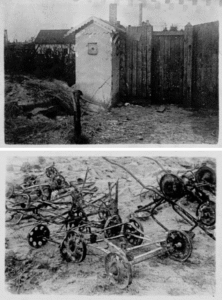
During the production of this series, previously unseen photographs of the Sobibor extermination camp surfaced. These images originate from the Central Archive of the Ministry of Defense of the Russian Federation.
Although the photographs were discovered in 2018, they have remained unknown until now. They shed new light on the camp, showing a chaotic site, partially intact, shortly after its liberation by Soviet troops. During the event, Erik Schumacher (NIOD), Bernolf Kramer (Stichting Sobibor), and podcast creator Richard Grootbod will discuss the significance of these findings.
More information and tickets (reservation required): Dutch Resistance Museum Amsterdam
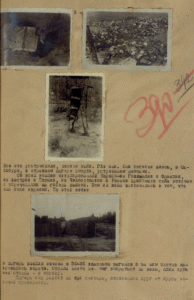
On August 19, 1944, Lt. Col. N.I. Volsky published a report on his findings in Sobibor.
The 17 photographs, taken on August 15, 1944, depict the guardhouse at the entrance, the “Rampe” where trains arrived, and the quarters of the camp guards. Heart-wrenching images show piles of baby carriages, tableware, and walking sticks. “The gas chambers were blown up,” says Bernolf Kramer of the Sobibor Foundation, “but a place where 170,000 people were robbed and gassed cannot be erased.”
Lt. Col. N.I. Volsky published a report on his findings in Sobibor on August 19, 1944.
The authenticity of the photographs has been confirmed, including by the family of Dutch survivor Ursula Stern, who appears in one of the images. The photos support suspicions that parts of the camp were not fully dismantled after the October 1943 uprising, contrary to previous assumptions.
Podcast Series: The Silence of Sobibor
The Silence of Sobibor is a production by Audiodroom Podcast Productions in collaboration with the Sobibor Foundation. Creators Patty-Lou Middel-Leenheer and Richard Grootbod spent a year and a half developing the series, which tells stories about the little-known Sobibor camp.
Sobibor was a secret death camp in Nazi-occupied eastern Poland, part of Aktion Reinhard, where over 170,000 people were murdered. Unlike Auschwitz, Sobibor remains largely unknown to the public.
Between March 2 and July 1943, 34,313 Jews were deported from the Netherlands to Sobibor in 19 transports. Almost all were murdered upon arrival. A small number were selected to work as Sonderkommando. On October 14, 1943, these “work Jews” organized an armed uprising. Hundreds managed to escape.
Only eighteen Dutch survivors returned from Sobibor: three men and fifteen women. Two of them, Selma Wijnberg and Ursula Stern, were held in Sobibor; the others were transferred shortly after arrival.
Among them was Jules Schelvis, who later authored several seminal works on Sobibor. King Willem-Alexander referenced Schelvis in his speech on May 4, 2020: “Sobibor began in the Vondelpark, with a sign that read ‘No Jews Allowed.’”
The photographs will be shown on October 12 during Sobibor: Resistance and Hope at the Dutch Resistance Museum. The podcast will be available from that day via app.springcast.fm/podcast/de-stilte-van-sobibor. The images will be shared later via our website.
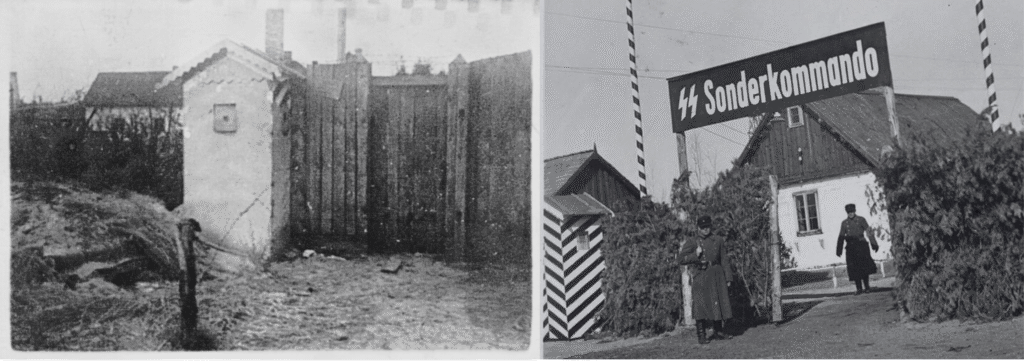
Comparison of the guardhouse at the entrance to the former Sobibor death camp in 1944 and 1942. (Photo from 1942 is from the Niemann Album, United States Holocaust Memorial Museum)