


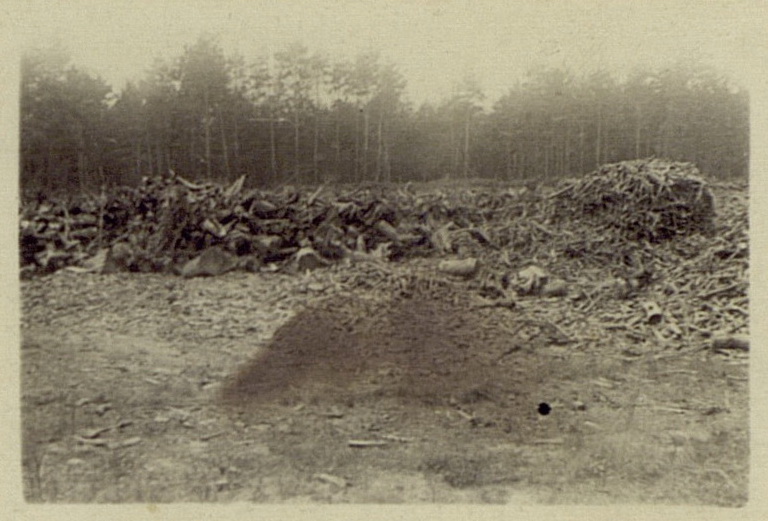
Photo of piles of belongings taken from deported Jews, presumably at the site of the former Lager 2, where the sorting barracks were located.
The photos on this page are unique witnesses to a place that has almost disappeared from our collective memory: the Sobibor extermination camp. While Auschwitz became a symbol of the Holocaust after the war, Sobibor fell into neglect. Yet more than 170,000 people were murdered here, including more than 34,000 Dutch Jews. Although the images were released by the Russian Ministry of Defense in 2018, they have remained unknown until now.
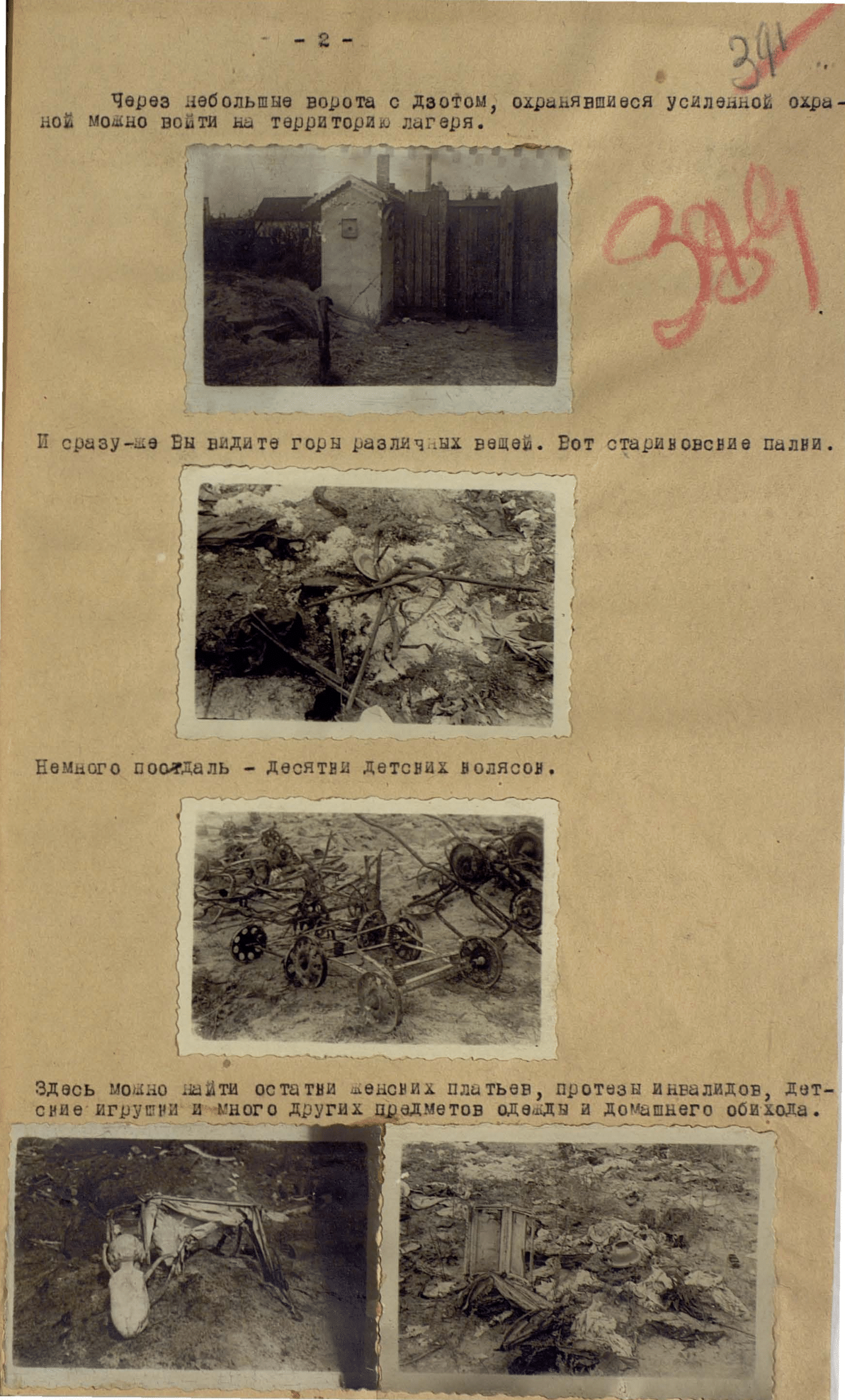
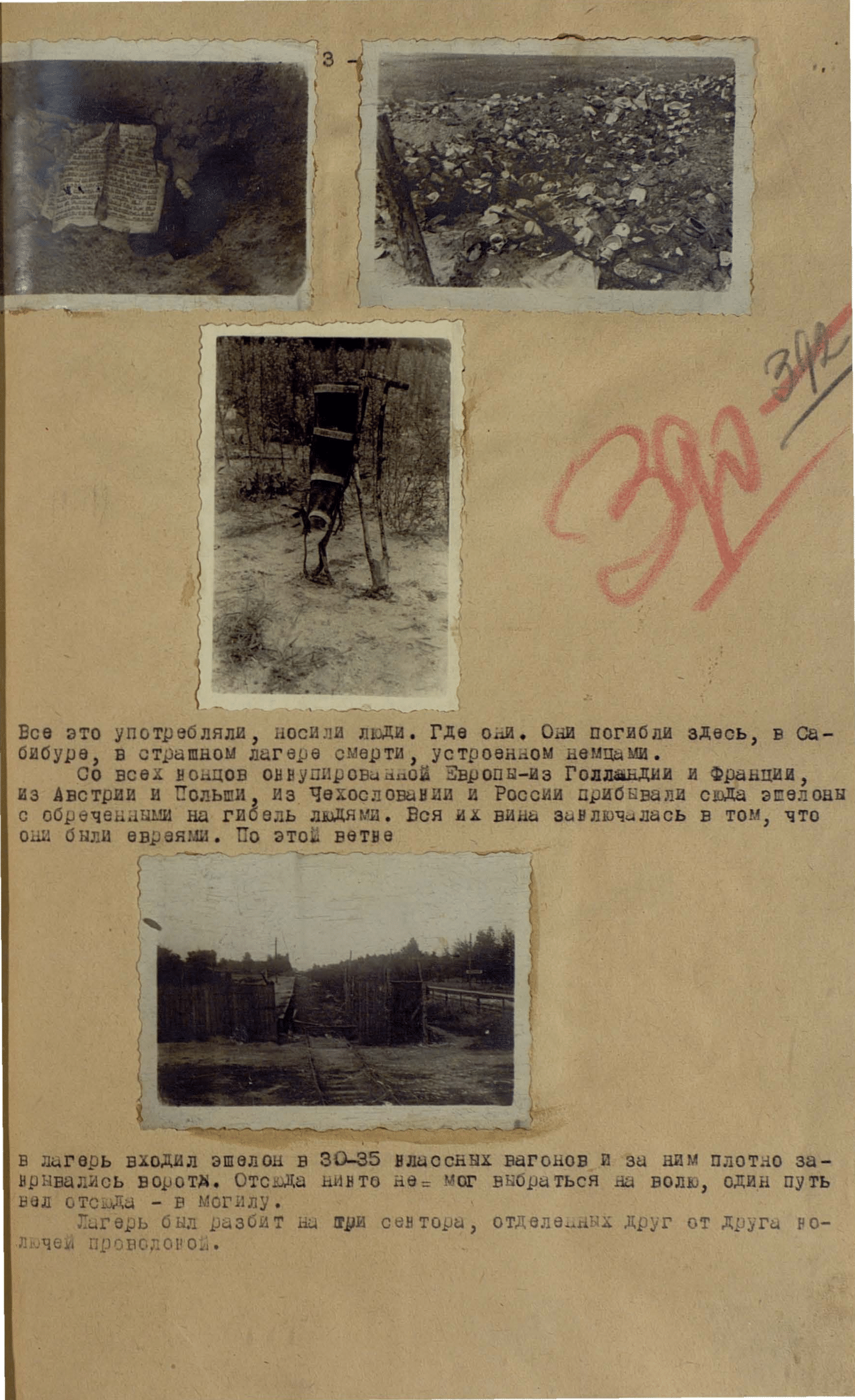
During the production of the seven-part podcast series De Stilte van Sobibor (The Silence of Sobibor), the creators were shown 17 unknown photos from the Central Archives of the Ministry of Defense of the Russian Federation, dating from August 19, 1944, shortly after the liberation of German occupied eastern Poland by Soviet troops. These images shed new light on the camp: they show, among other things, the guardhouse at the entrance to Himmelfahrtstrasse, the ‘Rampe’ where trains arrived, and poignant piles of prams, crockery and walking sticks. They also show that parts of the camp were not completely dismantled after the uprising of October 1943, as had long been assumed.
These are new images, different from the photos discovered in 2015 from the so-called Sobibor perpetrator album. Together, these sources provide a more complete picture of Sobibor and the crimes committed there.
The authenticity of the photos has been confirmed, among others by the family of survivor Ursula Stern (Ilana Safran), who can be seen in one of the images. These photos reveal what cannot be erased: a place where thousands of Jews lived their last moments.
With these images and stories, the Sobibor Foundation aims to contribute to knowledge, remembrance, and awareness. Listen to the podcast De Stilte van Sobibor [in Dutch, English podcast will be published later] to discover the stories behind these photos and other stories.
Sobibor Report 19-08-1944, from the Central Archives of the Ministry of Defense of the Russian Federation.
A translation of the Russian text follows, with some editorial comments on factual inaccuracies, below the photos.
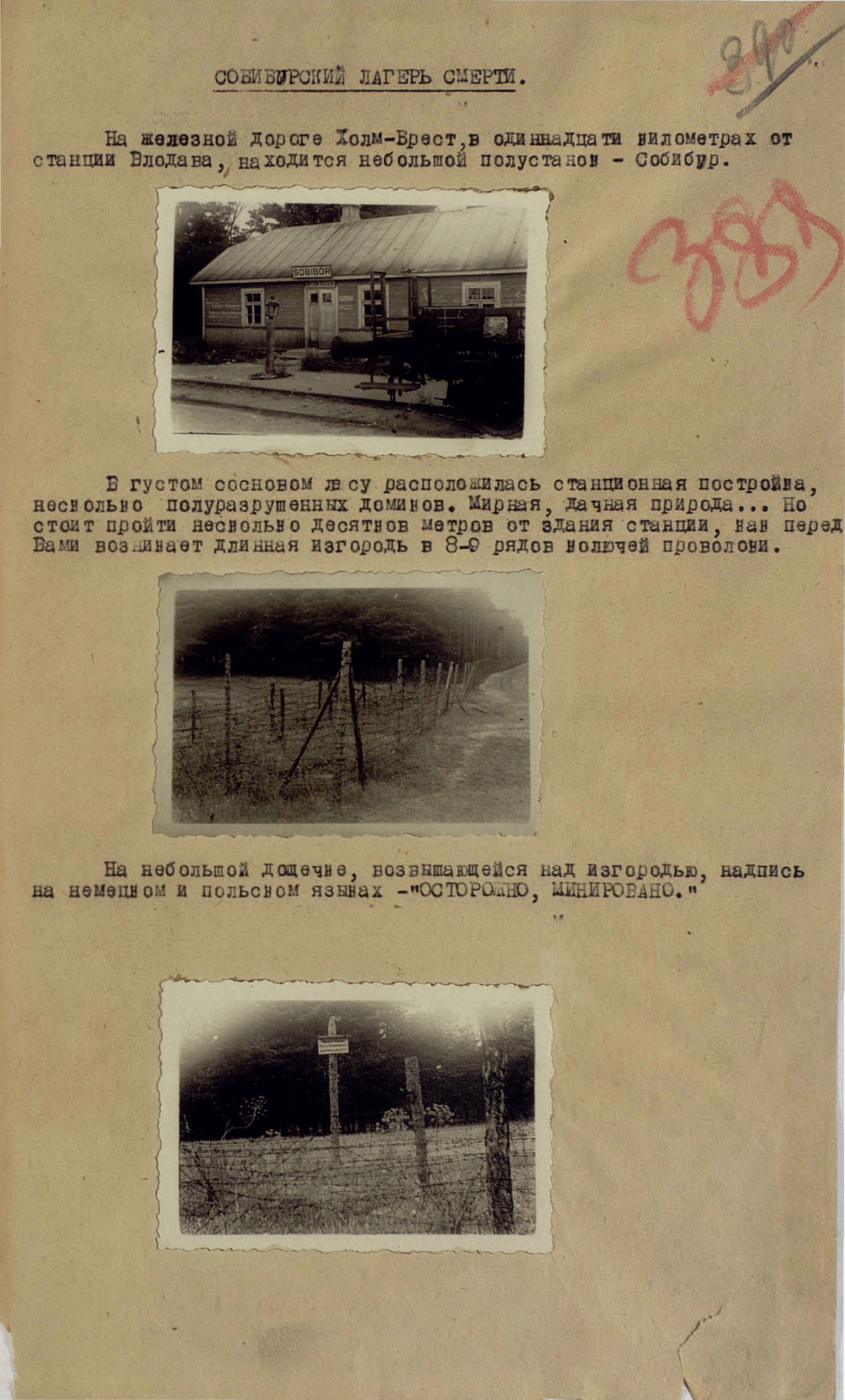
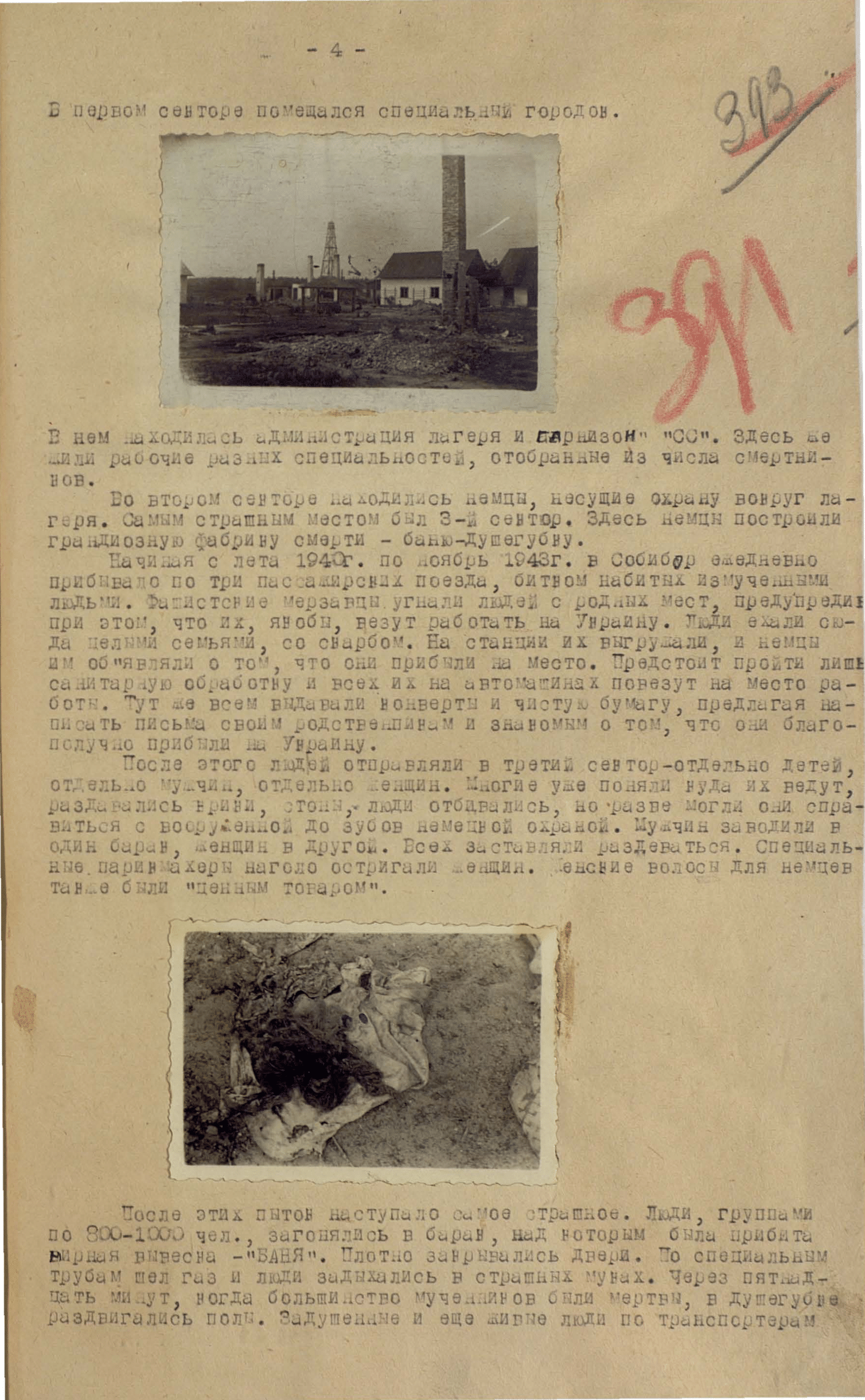
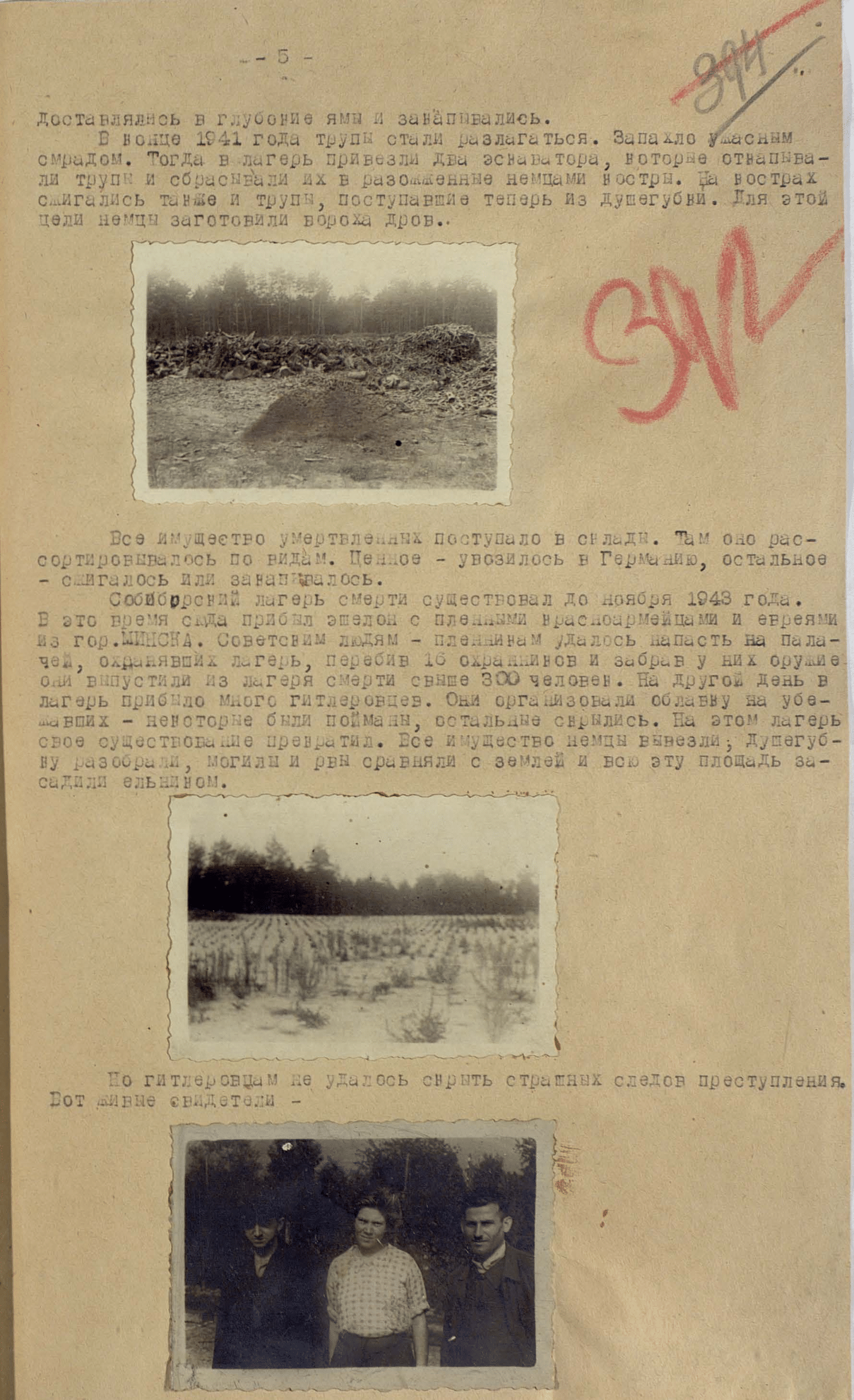
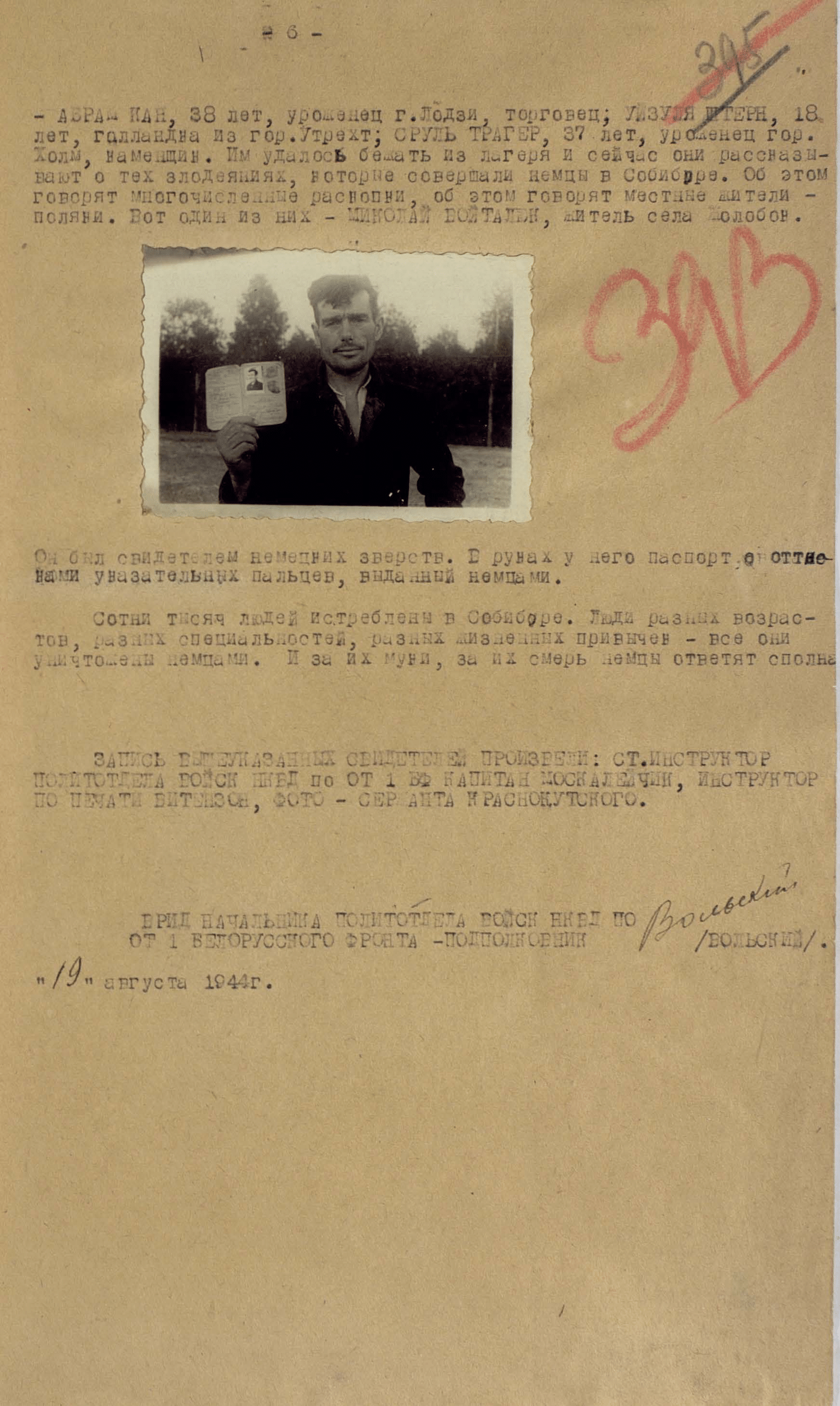
The Death Camp Sobibor
Along the Chełm–Brest railway line, eleven kilometers from Włodawa station, lies the small station of Sobibor.
In a dense pine forest stand a few station buildings and semi-derelict houses. A peaceful, rural setting… But only a few dozen meters further appears a long fence made of 8–9 rows of barbed wire. A sign above the fence reads in both German and Polish:
“WARNING, MINEFIELD.”
Inside the Camp
Entry to the camp was through a small gate with a bunker and heavy security. Immediately visible were piles of personal belongings:
-
Old suitcases
-
Dozens of baby carriages
-
Remnants of women’s dresses
-
Prosthetics from disabled people
-
Toys
-
All kinds of clothing and household items
All these items belonged to people.
Where are they?
They perished here, in the horrific extermination camp set up by the Nazis.
From across occupied Europe—The Netherlands, France, Austria, Poland, Czechoslovakia, Russia—trains arrived carrying people sentenced to death.
Their only “crime” was being Jewish.
Trains with 30–35 wagons entered the camp, after which the gates were sealed shut.
No one could escape.
There was only one way out: death.
The camp was divided into three sectors, separated by barbed wire.
The Camp’s Sectors
-
Sector 1: This housed the administration and the SS garrison. Prisoners with specific trades—selected from among the condemned—worked here.
-
Sector 2: This was where the German guards were stationed.
-
Sector 3: The most horrific part. Here, the Nazis built a mass extermination facility disguised as a bathhouse.
From the summer of 1940 [mid-April 1942, ed.] until November 1943 [end of September 1943, ed.], three passenger trains [one or more, ed.] full of exhausted people arrived daily.
The Nazis had deported them from their homes under the pretense of sending them to Ukraine for work. Families traveled together, bringing their belongings.
Upon arrival, they were told they had reached their “destination” and would first undergo sanitation procedures, after which they would be transported by truck to their workplaces. They were given envelopes and paper to write to their families, assuring them they had arrived safely.
Then they were taken to Sector 3: children, men, and women were separated.
Many realized what awaited them. Cries and sobbing could be heard. People tried to resist, but stood no chance against the heavily armed Nazis.
-
Men were taken to one building, women to another.
-
Everyone had to undress.
-
Women were shaved bald by special barbers — their hair was considered a “valuable product” by the Nazis.
Then the worst began:
-
Groups of 800–1,000 people were herded into a building marked “BATHHOUSE”
-
The doors were sealed airtight.
-
Gas was pumped in through special pipes.
-
People suffocated in terrible agony.
-
After about 15 minutes, when most were dead, the floors opened.
-
The bodies — dead and sometimes still alive — were transported via conveyor belts into deep ditches and buried.
Cremation of the Bodies
By the end of 1941 [1942, ed.], the bodies began decomposing, which caused a dreadful stench.
The Nazis brought in two excavators to dig up the corpses and burn them on pyres.
New victims from the gas chambers were also burned here.
-
The Nazis had stockpiled large quantities of wood.
-
Victims’ belongings were sorted:
-
Valuables were sent to Germany
-
The rest was burned or reused
-
The camp operated until November 1943.
In [late September 1943, ed.], a train arrived carrying Red Army prisoners of war and Jews from Minsk.
The Soviet prisoners revolted, killed 16 guards [twelve SS and two others, ed.], seized their weapons, and freed more than 300 people [see: Sobibor Uprising].
The next day, many Nazis arrived at the camp.
They launched a manhunt for the escapees: some were caught, others managed to flee.
Then the Nazis liquidated the camp:
-
Possessions were removed
-
The gas chamber was dismantled
-
Graves and ditches were leveled
-
The area was replanted with spruce trees
But the Nazis could not hide the traces of their crimes.
Witnesses
-
Abram Kohn, 38, from Łódź, merchant
-
Ursula Stern, 18, Dutch, from Utrecht
-
Israel Trager, 37, from Chełm, tailor
They managed to escape and now bear witness to the atrocities committed by the Nazis in Sobibor.
Local residents also confirm the brutality, including MIKOŁAJ BOJ TALŻ from the village of Małoziemce.
He possesses a passport with burned fingerprints, issued by the Nazis.
Hundreds of thousands of people—of all ages, professions, and backgrounds—were exterminated in Sobibor.
For their suffering and deaths, the Nazis will be held accountable.
Witness Statements Recorded By:
-
Captain Moskalenchi, senior instructor of the Political Department of the NKVD troops
(The People’s Commissariat for Internal Affairs, responsible for internal security and the pursuit of “enemies” at home and abroad, ed.) -
Vitenzon, press instructor
-
Photographs by: Sergeant Krasnokutski
Signed by:
Deputy Head of the Political Department of the NKVD Troops of the 1st Belorussian Front
Lieutenant Colonel Volski
Date: August 19, 1944