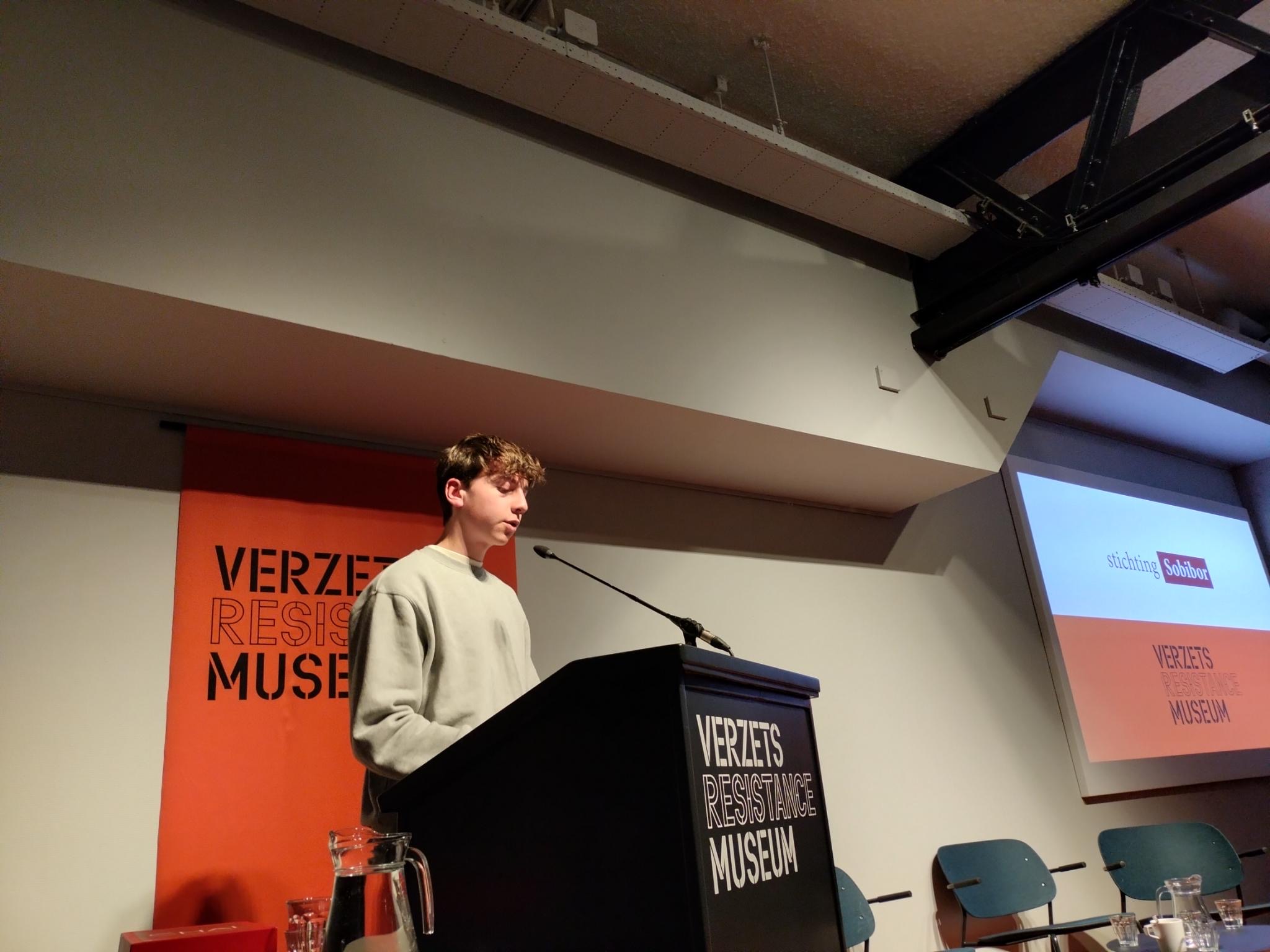
 The Sobibor Foundation is proud to announce that the Jules Schelvis Youth Prize 2023 has been awarded to Oscar Visser. His paper, “My Family and Sobibor” (Dutch) which stands out for its clear and almost matter-of-fact writing style, deals with the past of the Sobibor extermination camp in a way that is both informative and poignant.
Oscar, a high school student, has chosen an unusual perspective for his paper. Despite personal involvement through the loss of family members, including three in Sobibor and one in Auschwitz, he chooses to step back from individual suffering and focus on the facts: the decision making surrounding the construction of the camp, the executive leadership, the gruesome procedures and the physical layout of Sobibor.
Oscar’s paper gives space to the cold facts, after which he modestly connects to the personal by describing the history of four Stolpersteine in Amsterdam. The sober account of the uprising in Sobibor and the current state of the former camp form the conclusion of his argument, which, however, does not end before he echoes the appeal of Jules Schelvis himself: the story of Sobibor must continue to be told.
Through this approach, the suffering of individuals does not become a veil that obscures the view of the systematic processes of the Holocaust. On the contrary, it strengthens awareness of the immense impact of the events in Sobibor. Oscar demonstrates that a factual approach, in the spirit of Jules Schelvis’s own testimonies, does not mitigate the horror, but the call for remembered
With this piece of work, the Jules Schelvis Youth Prize becomes a symbol of the importance of remembering in a way that encourages thought and action. Oscar Visser’s approach has reinforced the mission of the Sobibor Foundation: to constantly remember and learn from history, so that it never repeats itself.
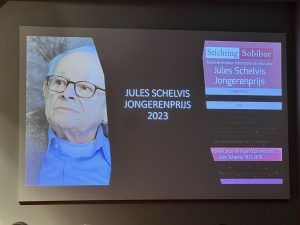
There were four entries this year.
- Pien Gubbels (Drawing with poem)
- Oscar L. Visser (Workpiece: My family and Sobibor)
- Jop van Schaik, Morris Kuijk, Ivo van Anraad, Jens Bunt (Profile paper Sobibor)
- Performing group of 20 young people within Stainless Theater (Shiwwe for Sobibor)
The jury decided unanimously to advise the board of the Sobibor Foundation to award the Jules Schelvis Scholierenprijs 2023 to Oscar Visser:
“Our considerations here were that Oscar’s piece reports on a process in which, by interviewing a survivor, he both gives that person the opportunity to tell his story and also becomes part of that process of passing on the story of Sobibor himself. It takes courage to do such a thing within the family and then, despite the personal connections, to keep a distance from the obviously highly charged and emotional subject. Oscar succeeded. His intention to travel to Poland with his grandfather, by the way, also indicates that the process is not yet complete.
We know from other stories, furthermore, that the point of completion is often not reached either. But that’s not a bad thing. We need each other to deal with this history. The narrator of the story – Oscar’s grandfather – steps in the footsteps of Jules Schelvis and the listener, by recording the story, also follows those footsteps.
Oscar was captivated by his family’s story and knew he had to interview his grandfather. It cannot fail to have deepened his relationship with his grandfather and – we noted – he also indicates that he still wants to visit the camps in former Nazi-occupied Poland with his grandfather. We find it very special that he wants to do that as a young man. If he succeeds, it will be a life-defining experience, perhaps healing for his grandfather, but it is certain that – should Oscar be given it – he will pass on and tell this story and visit to Sobibor to his own children and grandchildren in the future, in the spirit of Jules Schelvis.”.
A special mention by the jury is awarded to the acting group of 20 young people within Roestvrij Theater for the play Shiwwe for Sobibor. The jury: “sitting a shiwwe, that is observing the seven days of mourning when you have just lost a blood relative to death. Twenty young people, associated with Roestvrij Theater, have created unique performances in a series of over twenty performances that are different and tie in with specific stories of transports from Wersterbork to Sobibor. They did so in a way that made the audience feel – as befits a shiwwe – that the loss was recent and still felt in everything. An intensive project that must have made a great impression not only on the spectator, but also on the young people.”
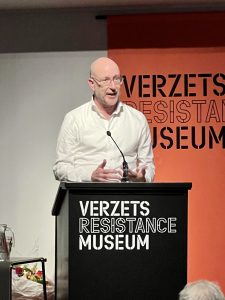 The Sobibor Foundation established this prize in 2020 for young people, who in a special way bring attention to the former Nazi extermination camp Sobibor and feel involved in contributing to the lasting memory of Sobibor. The Jules Schelvis Youth Prize consists of a certificate and a sum of €250.
Jury members for the Jules Schelvis Scholierenprijs 2023 were:
Jeroen van den Eijnde, director of National Monument Camp Vught, Maarten Eddes, former chairman of the Sobibor Foundation and Doede Sijtsma, from the Province of Gelderland since 2002 officially involved in developments in Sobibor.